
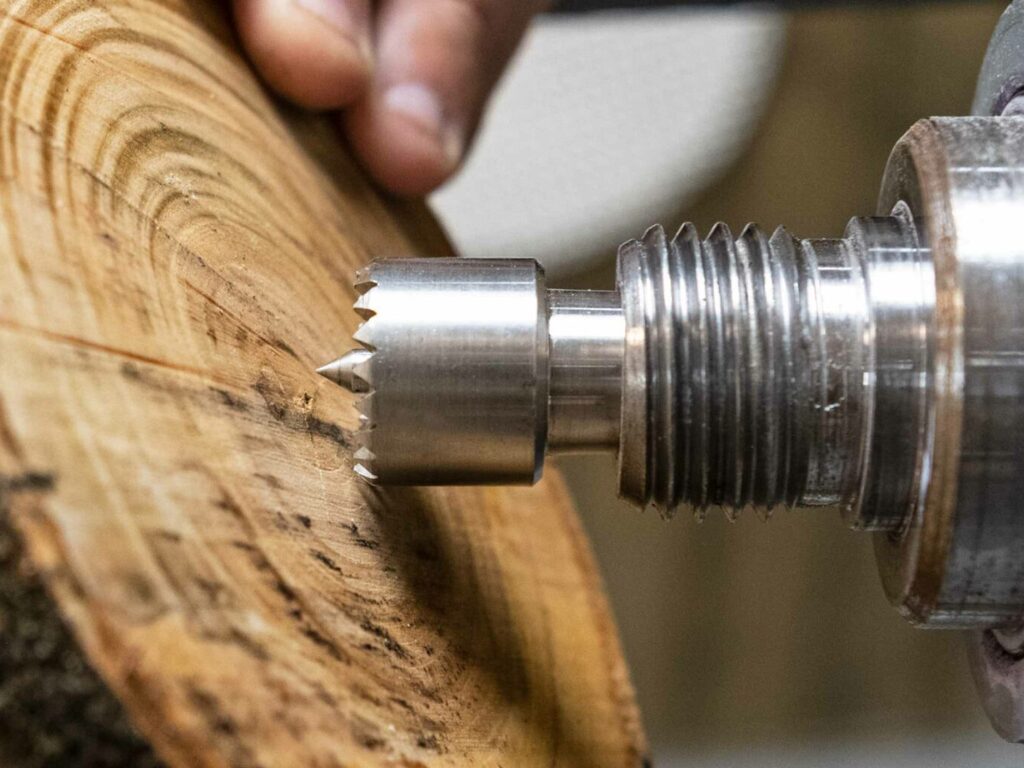
The drive centre of a woodturning lathe is one of the essential accessories for working on any piece of wood between centres. Its function is to establish a mechanical connection between the main rotation spindle or shaft of the lathe and the piece of wood, allowing the rotational movement and torque required to machine it safely and efficiently to be transmitted.
This component is mainly used in traditional woodturning, particularly during roughing, cylindrical turning, shaping and profiling. Despite its relatively simple construction, the drive centre is a mechanically important component. Its correct selection, preparation and installation have a direct influence on the concentricity of the workpiece, the transmission of movement and safety during operation.
What is a drive centre on a woodturning lathe?
The drive centre is the accessory fitted to the headstock of the lathe, rotating together with the main spindle. In between-centres work, it is installed in one end of the piece of wood, while the other end rests against the tailstock centre.
Its function goes beyond simply holding the wood. The drive centre must allow the rotational movement generated by the motor to reach the workpiece and prevent it from rotating independently during turning. The operation of the assembly can therefore be understood as a mechanical chain:
motor → lathe transmission → main spindle → drive centre → wood
The drive centre therefore acts as an intermediate component between the machine and the wood.
How does a drive centre work?
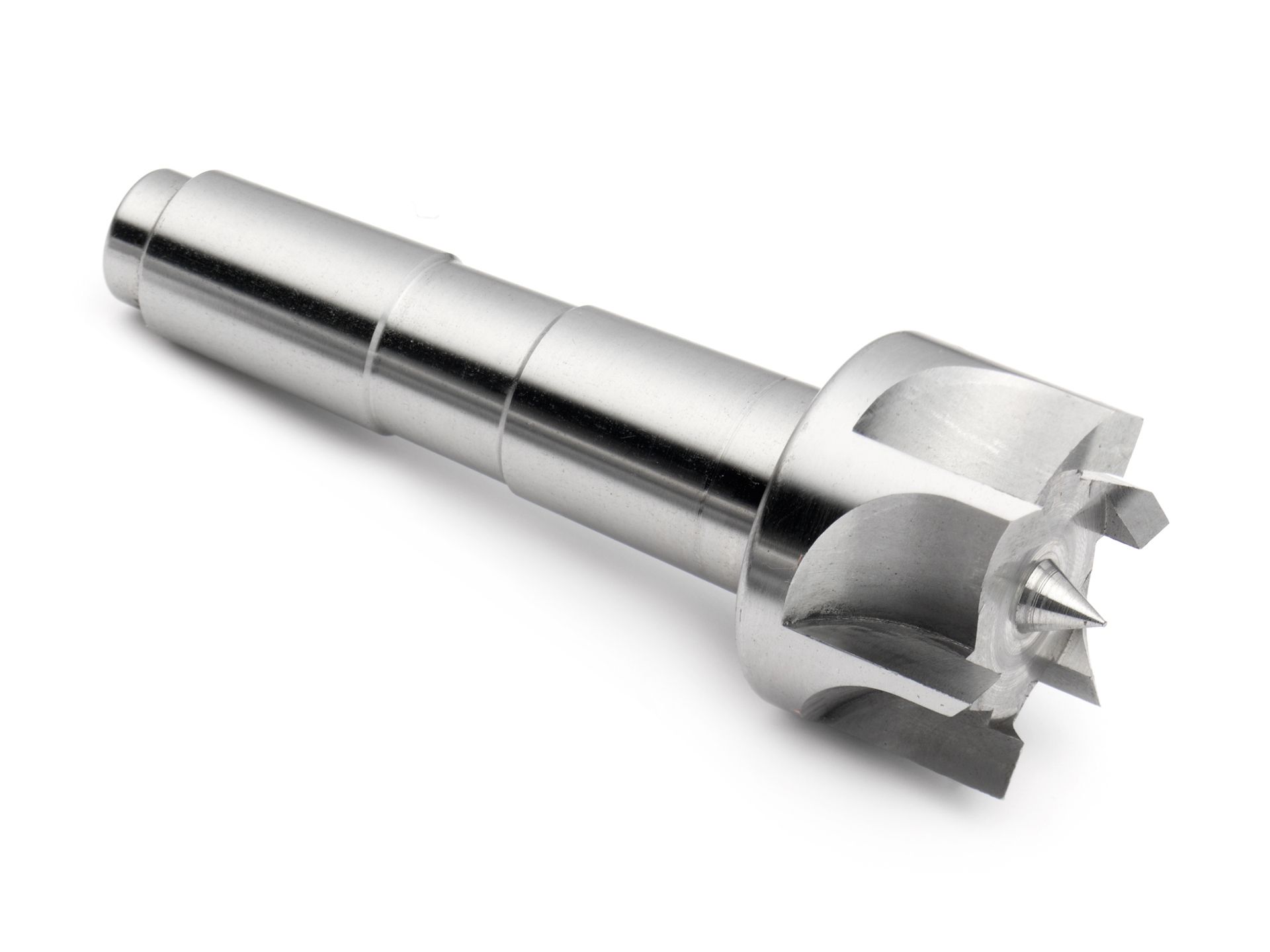
A conventional drive centre consists of a tapered shank, a central body, a centre point and usually four drive teeth, or alternatively, a toothed ring. When the drive centre is installed in the main spindle of the lathe, its shank is held in place by means of a Morse taper. When the motor rotates, it turns the drive centre and, with it, the drive teeth that have been driven into the wood.
The drive teeth transmit the rotational speed and torque of the motor to the wood. In this way, the workpiece rotates together with the main spindle and can be worked with standard woodturning tools. Would you like to know how a woodturning lathe motor works? Read our article Motor Torque, Power and Speed: Essential Concepts in Induction Motors for Woodturning Lathes.
This distinction is important: the centre point mainly contributes to positioning and centring, while the drive teeth are what establish the contact required to transmit the drive and movement.
The morse taper and the connection to the main spindle
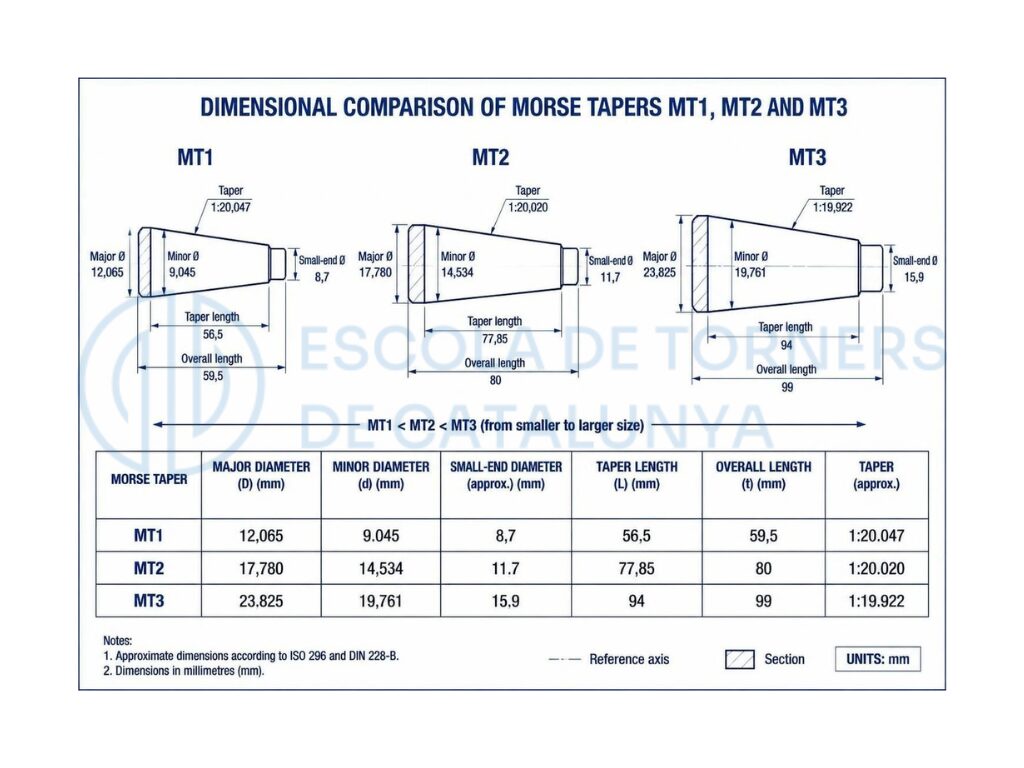
The connection between the drive centre and the main spindle of the lathe is usually made using a Morse taper, a standardised tapered coupling system.
The tapered shank of the drive centre is inserted into the internal socket of the spindle. The tapered geometry allows the two surfaces to fit together and create a firm connection based on fit and friction. Among the best-known standardised sizes are MT1, MT2 and MT3. In woodturning lathes, Morse 2 (MT2) is one of the most common configurations, particularly on medium-sized machines.
Keeping these surfaces clean is essential. The Morse taper and its socket must be free from wood shavings, dust, rust and grease residue. Any material trapped between the surfaces can prevent the shank from seating fully and affect the concentricity or stability of the accessory.
The drive teeth of the drive centre
The drive teeth, together with the centre point, are the elements that come directly into contact with the wood. They are made from hardened steel to withstand torsional forces and maintain their geometry under demanding working conditions.
Their main function is to continuously transmit the motor’s rotational torque to the wood, preventing it from slipping relative to the holding system.
The penetration depth of the drive teeth must be sufficient to guarantee a stable connection. An insufficient connection can cause the drive teeth to lose their grip during work, particularly when the tool applies a high load.
At the same time, it is not necessary to drive them further into the wood than required for secure fixing. The pressure applied to a wooden end grain should also be assessed according to the species, grain direction, condition of the wood and dimensions of the workpiece. Would you like to know more about the main wood species for turning? Read our article Types of Wood for Woodturning: Discover the 7 Main Woods for Woodturning Enthusiasts.
What is the function of the centre point?
The centre point of the drive centre allows the centre of the wooden workpiece to be located, facilitating the initial positioning of the accessory. Before mounting a piece between centres, its centre must be correctly determined. The centre point helps maintain this reference while the drive teeth are driven into the wood through pressure applied by the tailstock.
This has a direct consequence on the behaviour of the workpiece: incorrect centring can cause eccentricity, vibration and imbalance during rotation.
Maintenance and sharpening of the drive centre
Maintenance of the drive centre is simple, but it has a direct effect on the quality of the fixing and the ability to transmit the motor’s torque to the workpiece. A properly maintained drive centre must retain both the good condition of the drive teeth and the geometry of the assembly.
Some drive centres, particularly models designed for professional use, incorporate an internal hole that allows the centre point to be removed. This system considerably facilitates maintenance tasks and offers several adjustment possibilities:
· Easier and more precise sharpening: allows the centre point to be removed from the body of the drive centre and sharpened independently.
· Replacing the centre point: in the event of excessive wear, deformation or damage, the centre point can be replaced without having to replace the entire drive centre.
· Height adjustment: some models allow the height of the centre point relative to the drive teeth to be adjusted, adapting its position to the requirements of the work.
The drive teeth must work uniformly
One of the most important aspects is keeping all the drive teeth correctly sharpened and with a uniform geometry. Sharpening should leave the cutting edge of the drive teeth flat and regular, without deformation or irregularities. The geometry of the cutting edge should remain consistent with the original design of the drive centre and, in particular, the drive teeth must retain the same height.
This last point is fundamental. If one drive tooth is higher than the others, or there are differences in height between them, they will not all penetrate the wood in the same way. As a result, the driving force will not be distributed evenly between them. One or more teeth that are higher than the rest will penetrate the wood sooner or more deeply, while another tooth that is lower may have insufficient contact. The result is an unbalanced transmission of torque, which can reduce the holding capacity and encourage the workpiece to slip around its own axis of rotation.
The centre point requires maintenance
The centre point has an essential function when positioning the workpiece and must therefore also be kept in good condition. The tip of the centre point should retain a defined shape and be sufficiently sharp to locate the centre of the end grain accurately. With use, the tip can become worn and eventually develop a rounded end.
An excessively rounded point makes centring more difficult and can make it harder to keep the drive centre exactly on the centre mark of the workpiece. It is therefore advisable to touch it up and keep the point well defined. It is also necessary to check that the centre point is not misaligned relative to the axis of the drive centre. Deformation or misalignment can affect the positioning of the workpiece and compromise the concentricity of the setup.
The relationship between the drive teeth and the centre point
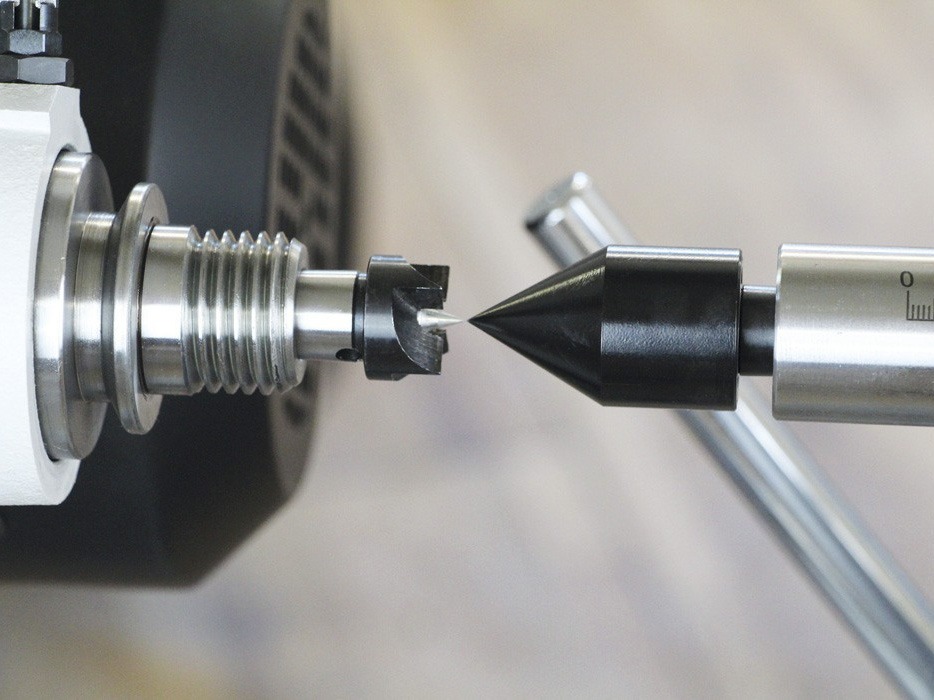
There is another particularly important geometric aspect: the drive teeth must remain below the height of the centre point. The centre point must be the element that first locates the centre of the workpiece. If any of the drive teeth protrudes above the centre point, the latter may no longer perform its centring function correctly.
Therefore, when inspecting or sharpening the different parts of a drive centre, it is not enough to check the drive teeth individually; the height relationship between them and the centre point must also be considered.
Common errors when installing a drive centre
Some of the most common problems are related to incorrect preparation or installation:
· Dirty Morse taper. Wood shavings or dirt can prevent the shank from seating fully inside the spindle.
· Incorrect centre location. If the drive centre is not positioned correctly on the axis of the workpiece, it may rotate eccentrically.
· Insufficient penetration of the drive teeth. This can cause slipping between the drive centre and the wood.
· Incorrect tailstock pressure. Insufficient pressure can compromise the fixing; excessive pressure can place unnecessary loads on the workpiece or lathe components.
· Starting work at too high a speed. Particularly with large or unbalanced workpieces, the first contact with hand tools should be made at low speed in order to check the stability of the assembly.
Safety when using a drive centre
Before starting the woodturning lathe, check that the drive centre is correctly installed, that the workpiece is properly centred and that the drive teeth have been adequately driven into the wood.
When working between centres, it is also necessary to check that the tailstock is correctly positioned and applying appropriate pressure. The first cutting operations should be carried out at low speed, particularly when the workpiece is irregular, unbalanced or still contains a large amount of material. Once it has been confirmed that the assembly is rotating steadily, the speed can be increased progressively according to the characteristics of the workpiece and the working conditions.
Frequently asked questions
What Are the Drive Teeth on a Drive Centre Used For?
The drive teeth penetrate the wood and transmit the motor’s rotational speed and torque to the wood, preventing the workpiece from slipping around its own axis of rotation.
What Is the Function of the Centre Point?
The centre point is mainly used to locate the centre of the workpiece and facilitate its centring relative to the axis of rotation.
What Type of Taper Does a Drive Centre Use?
Drive centres are usually connected to the main spindle of the lathe using a Morse taper system. MT2 (Morse 2) is one of the most common sizes on woodturning lathes, although this depends on the model and year of manufacture of the lathe.
Do the Drive Teeth on a Drive Centre Need to Be Sharpened?
Yes. The drive teeth must be kept correctly sharpened so that they can engage properly with the wood and transmit movement effectively.
Do the Drive Teeth Need to Be the Same Height?
Yes. It is important that all the drive teeth maintain the same height and a uniform geometry**.** If there are differences, they may contact the wood unevenly and cause an irregular distribution of the driving force.
What Happens if the Drive Teeth Are Higher Than the Centre Point?
If the drive teeth protrude above the centre point, the latter may no longer perform its centring function correctly and precise positioning of the workpiece may become more difficult.
Why Is It Important to Keep the Centre Point Sharp?
A well-defined centre point makes it easier to locate the centre of the workpiece. If it is rounded or misaligned, centring may become less precise and make a concentric setup more difficult.