
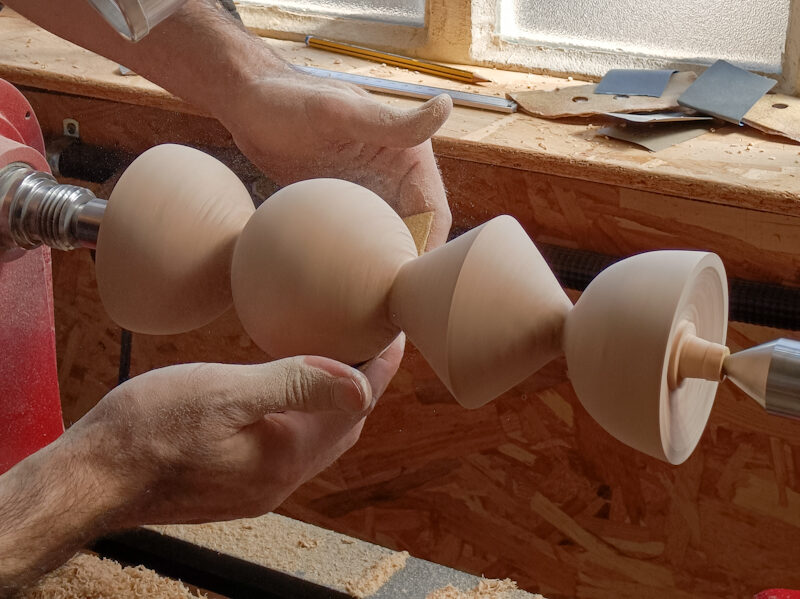
Introduction: what is abrasive paper and why is it so important in woodturning?
In woodturning, the work does not end with shaping a piece of wood. Polishing and surface finishing are key stages to achieve an aesthetic piece, well finished, soft to the touch, ready to apply a finish to its surface and with greater durability.
Sandpaper, also known as abrasive paper, owes its name to the fact that, in the 18th and 19th centuries, it was manufactured by gluing glass powder onto paper to polish surfaces. Although it was soon replaced by more resistant minerals, such as corundum or silicon carbide, the popular expression remained, and is still used today to designate what is technically called abrasive paper .
Sandpaper is an essential tool. Although it may seem like a simple resource, it hides behind a wide variety of abrasive materials, supports and formats that can make the difference between an amateur finish and a professional result.
Technical composition of abrasive paper
All abrasive paper is composed of three structural elements, where each of these elements determines the resistance, flexibility and efficiency of the product in polishing and surface finishing processes.
1. Support (Backing)
The support is the base on which the abrasive grains adhere and can vary depending on use:
- Paper: lightweight, flexible and economical; ideal for craftwork and fine finishes.
- Fabric (cotton, polyester or blend): offers greater mechanical resistance and durability, recommended for polishing with machines.
- Vulcanized fiber or synthetic films: used in demanding industrial applications, providing dimensional stability and heat resistance.
2. Adhesive (Bonding)
The adhesive fixes the abrasive grains to the support and ensures their durability. Two layers are usually used:
- First layer (make coat): initially holds the grain.
- Second layer (size coat): seals and protects the assembly, increasing wear resistance.
The most common adhesives are animal glue , natural resin , or, in modern applications, synthetic (phenolic) resins , which better resist heat and pressure.
3. Abrasive grain
It is the active element responsible for cutting and controlled wear of the surface. The most commonly used materials are:
- Aluminum oxide: versatile, resistant and for general use on wood and metal.
- Silicon carbide: harder and more brittle, ideal for hard materials such as glass, stone, ceramics or plastics.
- Zirconia or ceramic: with high self-sharpening capacity, they are used in highly demanding industrial applications.
4. Type of coating (Coating)
Grains can be distributed in two ways:
- Open coat: leaves free spaces between particles to reduce saturation with dust and debris.
- Closed coat: the grains cover almost the entire surface, providing more aggressiveness in the removal of material.
Thanks to this combination of backing, adhesive and abrasive grain , sandpaper is suitable for multiple applications: from aggressive roughing to fine finishing and precision polishing .
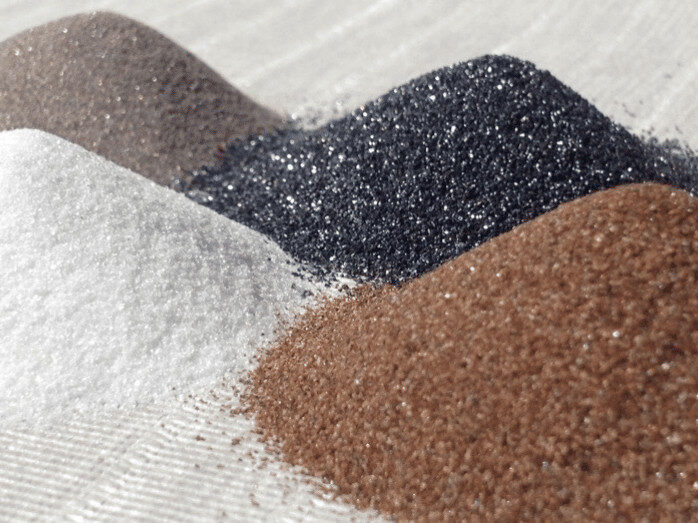
Classification of abrasive grain in sandpaper
The abrasive grain is the active component of sandpaper and determines its cutting ability and the quality of the surface finish . Choosing the right grain is essential in woodturning and sanding work, as the size of the abrasive particles directly affects both the speed of material removal and the smoothness of the final result.
The classification of abrasive grain is based on international standards such as the FEPA standard , the CAMI in the United States or the JIS scale in Japan.
Abrasive grain classification systems
FEPA system (P-grits)
The most widely used system for sandpaper in Europe. It is represented by the letter “P” followed by a number (for example, P80 or P240 ).
- Low numbers (P40–P80): coarser grains (125–200 µm), ideal for roughing and rapid material removal.
- High numbers (P220–P600 or higher): fine grains (less than 30 µm), used for delicate finishing and wood polishing.
CAMI system
This system, common in the United States , is similar to FEPA but without the letter “P.” Although the correspondence is close, the values are not always exactly equivalent, which must be taken into account when comparing abrasive papers.
JIS system
Widely used in Japan, especially in sandpapers intended for metal and electronics. It offers extremely fine classifications, reaching 8000 grit or higher , ideal for polishing precision surfaces.
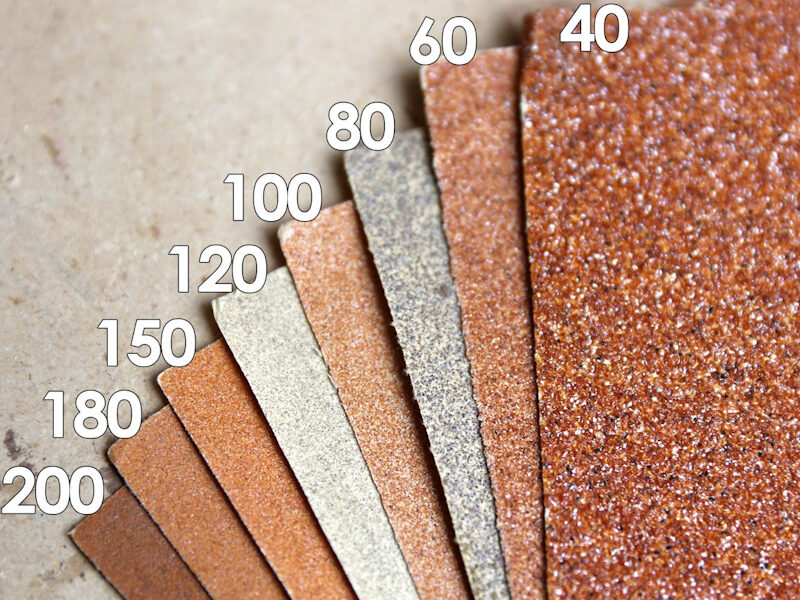
How does the size of the abrasive grain influence it?
The grain size of the abrasive paper determines how the grain size affects working with wood. Coarse grits remove material quickly and are ideal for the initial stages, but wear down the paper more quickly and leave rough surfaces. Medium grits offer a balance between efficiency and softness, being perfect for general carpentry work. Fine grits provide a smooth and even finish, essential before applying varnishes, oils or paints, although they are more delicate and can become clogged with dust or resins.
The grain size is measured by the diameter of the particles, usually in micrometers , and is indicated by a number: the higher the number, the finer the grain. Choosing the right grain size for the type of wood and the stage of the process is key to achieving an optimal finish and maximizing the durability of the sandpaper.
The grain size of the abrasive paper directly affects three fundamental aspects:
Durability of sandpaper → coarse grains wear out faster but resist dust saturation better.
Material start-up speed → faster with coarse grains.
Surface finish quality → smoother and more uniform with fine grains.
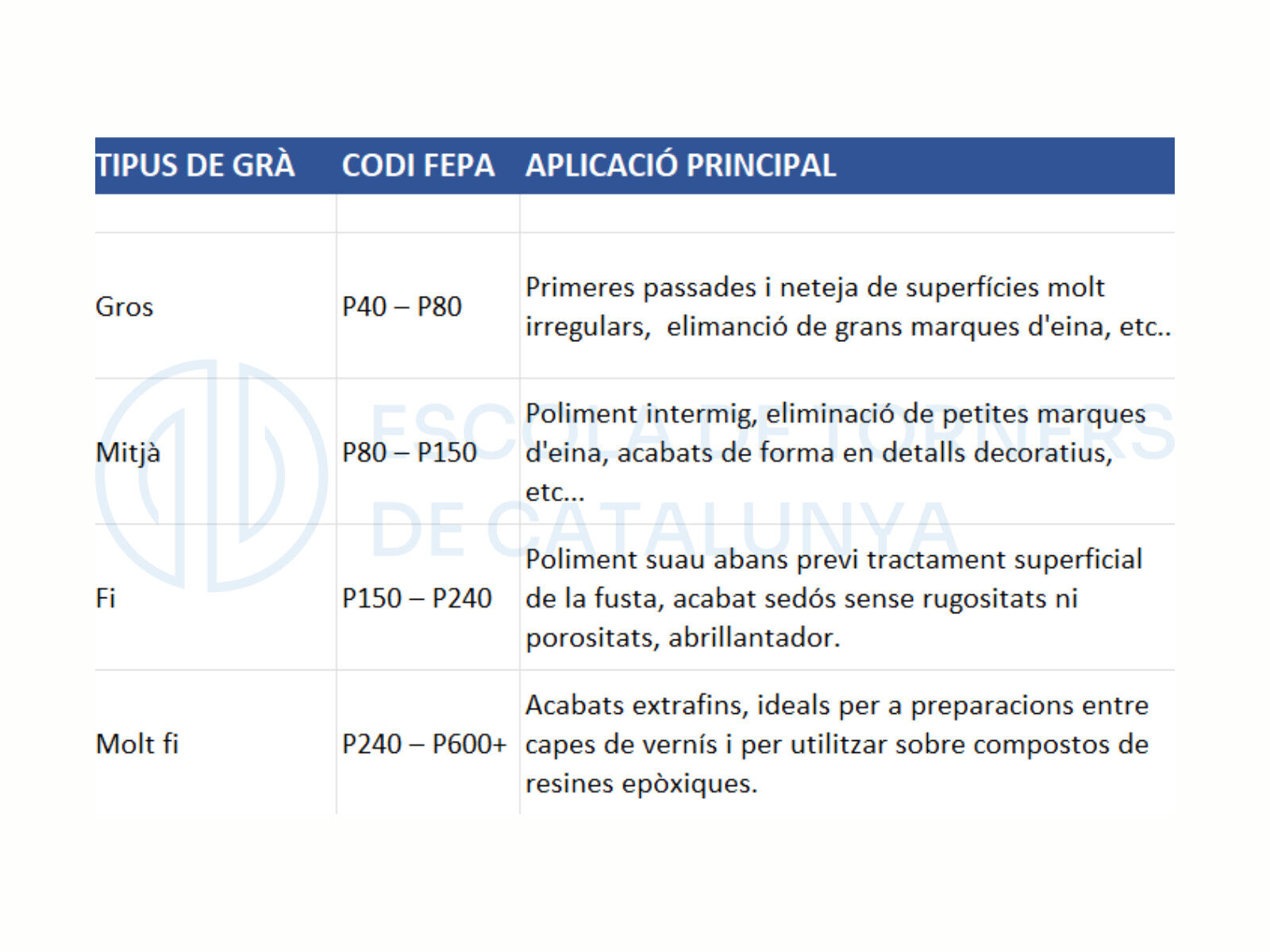
👉 Workshop tip: always move forward progressively. Jumping from a P80 to a P240 can leave visible scratches that are difficult to correct.
Types of abrasive paper backing: flexibility, resistance and performance
Abrasive paper is much more than a simple tool for scratching or polishing surfaces. Its effectiveness depends largely on the type of support on which the abrasive grains are fixed. This support can range from a light and flexible paper , ideal for delicate work, to a more resistant and robust fabric , designed for intensive use. Choosing the right support determines the resistance , flexibility and durability of the abrasive paper, as well as its adaptability to different materials and surfaces.
Choosing the right backing is essential to ensure working comfort , sanding precision and a perfect finish on the treated surfaces . Understanding the characteristics of the different types of backing allows you to better appreciate the complexity of this seemingly simple material and understand why its selection directly influences the performance and versatility of the abrasive paper in professional and domestic applications.
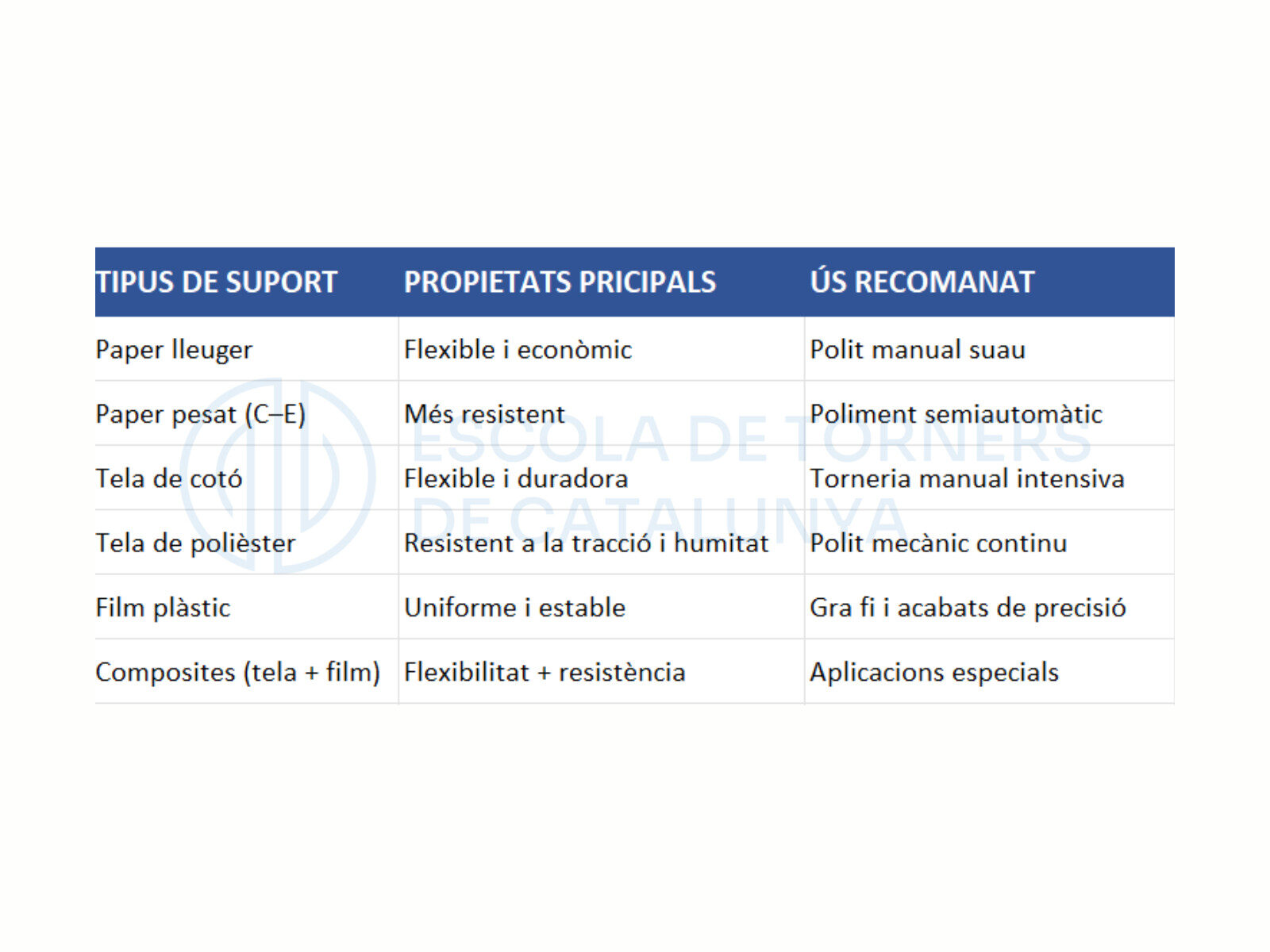
👉 For manual turning , flexible supports (cotton or light paper) are the most used, as they are better suited to demanding curves and complex profiles.
Commercial formats of abrasive paper
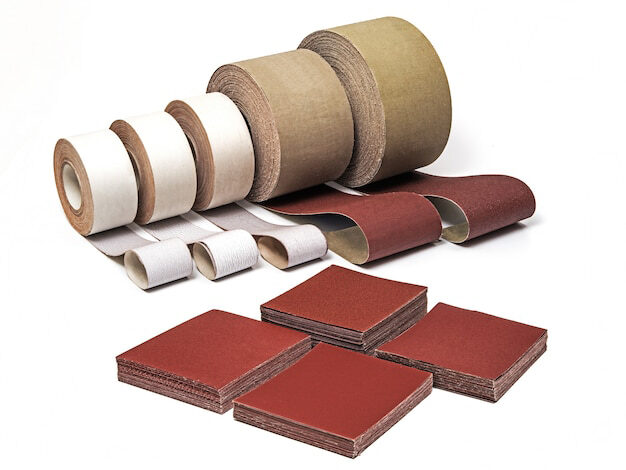
Abrasive paper is sold in different formats to adapt to each process:
Abrasive sponges and blocks: ideal for irregular areas and smooth finishes.
Sheets: easy to cut to size.
Rolls: widely used in turning, versatile and practical.
Abrasive discs: with or without velcro, for machine polishing.
Belts: for continuous polishing machines.
Correct procedure for sanding wood with abrasive paper
- Lathe speed: keep between 600–1400 rpm to avoid burns (guide values)
- Grit sequence: start with P80–P100 and progress to P150–P320.
- Appropriate pressure: moderate and uniform; it is the grain that does the work.
- Constant movement: polishing requires constant movement of the paper to avoid scratches on the surface of the wooden piece or its deformation due to wear.
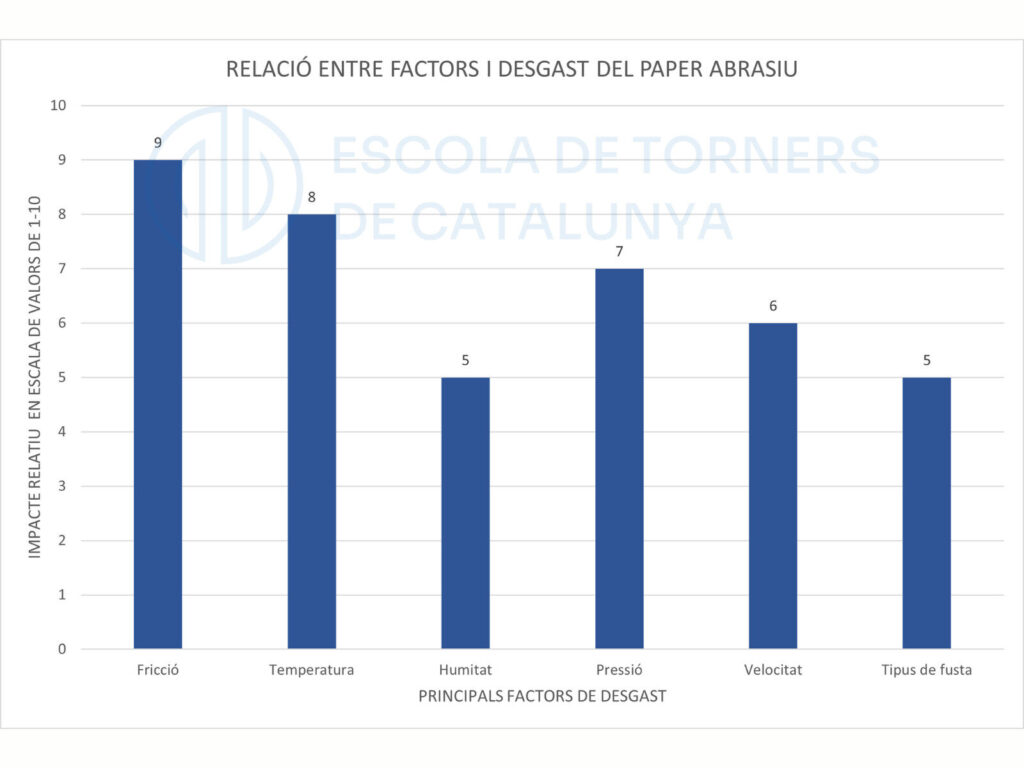
Factors that determine the wear of abrasive paper
1. Friction factor
Friction is the main mechanism of wear, as it is the force acting between the abrasive grains and the surface of the piece. When friction is too intense, heat is generated and accelerated grain loss occurs. Well-controlled friction, on the other hand, allows efficient cutting without rapidly deteriorating the support.
2. Temperature factor
The temperature increases directly with friction and speed. Excessive heat can detach the abrasive grains from the base, burn the wood and render the abrasive paper useless. For this reason, it is preferable to work with short passes and allow cooling intervals, or use abrasive papers with heat-resistant treatments.
3. Wood moisture factor
The moisture content of the wood plays a key role in wear. Wood that is too wet tends to saturate the paper, as the dust compacts and clogs the spaces between the abrasive grains, reducing its cutting ability. On the other hand, very dry wood can be harder and more abrasive than the abrasive paper itself.
4. Pressure
The pressure applied during sanding is one of the most critical factors. Too much pressure breaks the abrasive grains and prematurely wears the backing, while too little pressure only caresses the surface and is not efficient. The key is to maintain a constant and moderate pressure, which allows for a regular cut without damaging the abrasive.
5. Lathe rotation speed
The rotation speed of the lathe determines the speed of contact between the abrasive and the surface. If it is too high, excess heat and wear are generated, with the risk of burns on the piece. If it is too low, the work becomes slow and ineffective. Correctly adjusting the revolutions per minute (RPM) according to the type of wood and the grain size of the abrasive paper is essential to optimize its performance.
6. Type of wood
The type of wood also determines wear. Hardwoods (ash, oak, maple) wear out the abrasive paper more quickly due to their mechanical resistance, while softwoods (pine, poplar, plane tree) can clog the paper with resins and sticky dust. For this reason, it is essential to adapt the grain, backing and coating of the sandpaper according to the type of wood to extend its life and improve the efficiency of the sanding.
Good practices and safety in polishing
- Do not use gloves: risk of getting caught in the lathe.
- Respiratory protection and ventilation: wood and abrasive dust is harmful.
- Take short breaks: to avoid overheating the wood and paper.
- Avoid damp wood or fresh varnish: they quickly clog the paper.
Advanced applications and alternatives to sandpaper
- Water abrasion: with water-resistant paper, ideal for extra-fine finishes and between layers of varnish.
- Abrasive pastes with cloths or sponges: for micro-polishing and decorative pieces.
- Alternative abrasives: such as microfiber discs or cerium oxide for special finishes.
Frequently Asked Questions (FAQ)
1. Which abrasive paper is best for sanding wood?
One of the most recommended papers is aluminum oxide. It starts with a medium grain (P80–P100) and ends with a fine grain (P240–P320).
2. What is the best format of abrasive paper for turning?
Flexible rolls and sheets are the most versatile for manual turning.
3. Is sandpaper and abrasive paper the same thing?
Yes. “Sandpaper” is the popular name, while “abrasive paper” is the technical term.
4. How to extend the service life of abrasive paper?
Working with moderate speed, controlled pressure and avoiding overheating the paper and the piece of wood.
Conclusion
Abrasive paper is much more than a basic consumable: it is a precision tool in wood polishing. Its correct selection (grain, backing and format) and appropriate use make the difference in the quality of the finished piece.
An expert turner not only knows how to work with his hand tools, but also masters sanding with abrasive paper, achieving smooth, durable and professional finishes.