
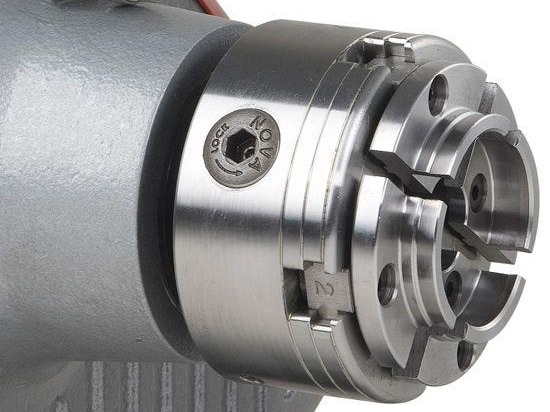
In wood turning, the universal plate, also known as a clamp plate, self-centering plate or clamp plate, is an essential accessory for quickly and safely holding any piece of wood on the lathe. This element allows you to work with cylindrical, prismatic or slightly irregular pieces, ensuring automatic centering and stability during machining.
Despite its simple appearance, the universal plate is a sophisticated mechanical system. Its main function is to transmit pressure and radial forces onto the piece of wood, with the aim of a secure, distributed and tight hold over the entire surface of the material.
What is a universal plate or jaw plate?
The universal plate is a clamping system that is installed on the lathe head, specifically on the external thread of the transmission shaft, and that allows a piece of wood to be held using clamps. These jaws open and close in a linear and precise manner, depending on the size of the wood they need to hold or the turner’s demand. In this way, they allow constant and distributed pressure to be generated over the entire surface in direct contact with the wood.
Once the jaws of a universal plate are tightened, the entire assembly provides an ideal and sufficient rotation to be able to turn the wood and come into contact with it (friction), without loss of mechanical traction.
Main advantages:
- Fast and automatic centering of wooden pieces
- Uniform clamping at four radial points
- Ideal for cylindrical, prismatic or slightly irregular cross-section pieces
- Facilitates repetitive work without the need for additional measurements or adjustments
Operation of the universal plate
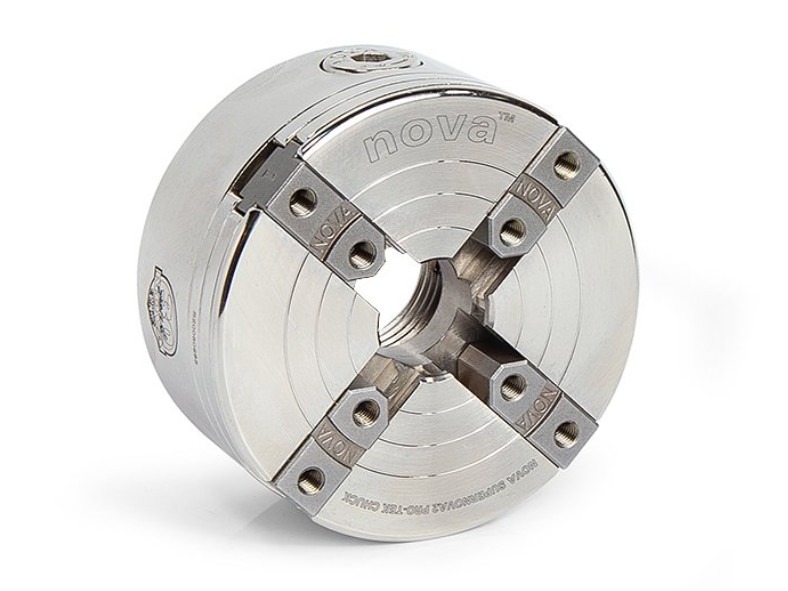
The operation of the universal plate is based on the coordinated movement of the four jaws, which work in sync to hold the piece of wood with precision. The operator turns the key of the plate, and the drive pinion transmits this movement to the spiral crown. At the same time, this crown converts the rotation into a uniform radial displacement of the 4 jaws, which apply a balanced force on the piece. When this force is distributed between the four jaws, automatic centering, uniform clamping and the ability to resist both the cutting forces of hand tools and the vibrations generated during turning are guaranteed.
The performance of the mechanism depends directly on the torque applied and the state of wear of all the components of the universal plate, since any irregularity can affect the accuracy and efficiency of the clamping. The performance and accuracy of the mechanism depends on the torque applied with the manual wrench.
Main components of the jaw plate
A self-centering staple plate is made up of:
Main body: structure that houses the mechanism. The body of the plate is the central and structural element on which all the components of the clamp plate are anchored. It functions as the skeleton of the tooling, providing rigidity and resistance to the force applied during the clamping of the wooden pieces. Industrial universal plates are often manufactured with materials that respond to specific needs:
Gray cast iron , valued for its excellent vibration absorption capacity; nodular cast iron , which offers greater resistance and toughness; and forged steel , common in high-end professional equipment for its durability and robustness. In the case of wood turning, most universal plates are manufactured with light cast iron or treated steel, since the force applied is lower than in metallurgical work, but it is essential to maintain the rigidity of the mechanism to guarantee precision and safety in the clamping. Chrome plating is a common surface coating on universal plates, used on some external components or accessories when high protection against oxidation and wear is sought. This treatment consists of applying a thin layer of chromium that acts as a barrier against moisture and corrosive agents, while improving surface hardness. Despite its advantages, chromium plating is used sparingly in functional elements, as it can slightly alter mechanical tolerances and affect the fit of parts. For this reason, it is usually reserved for non-critical parts or parts with higher aesthetic and durability requirements, such as the main body or external jaws.
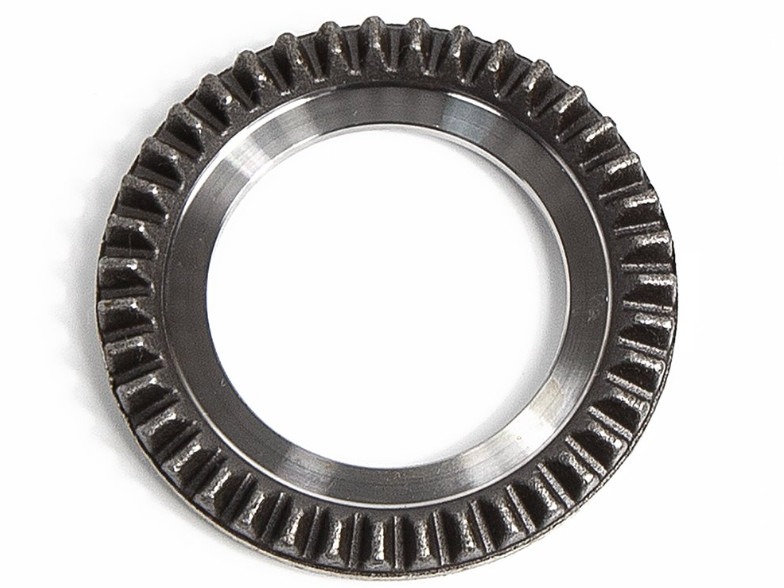
Spiral crown: is a key element in all self-centering chucks. Its main function is to convert the torque applied by the manual wrench to the satellite axis into a radial displacement of the jaws, allowing them to open or close uniformly and synchronously. This mechanism ensures that the clamped piece is automatically centered, improving precision and reducing the risk of displacement or slippage during turning. The design and quality of the spiral plate material are crucial to ensuring smooth movement, precise adjustment and high durability of the plate assembly. Spiral crowns are usually made of materials with high strength and good toughness, capable of withstanding the torque applied repeatedly without deforming. Among the most common materials are:
Treated steel : very common in wood turning, it combines strength and durability with a certain flexibility for smooth jaw movement.
Hardened alloy steel : used in professional or high-end equipment, it offers greater wear resistance and extended service life.
Nodular cast iron : less common, but can appear in industrial dishes where good fatigue resistance and some toughness are required.
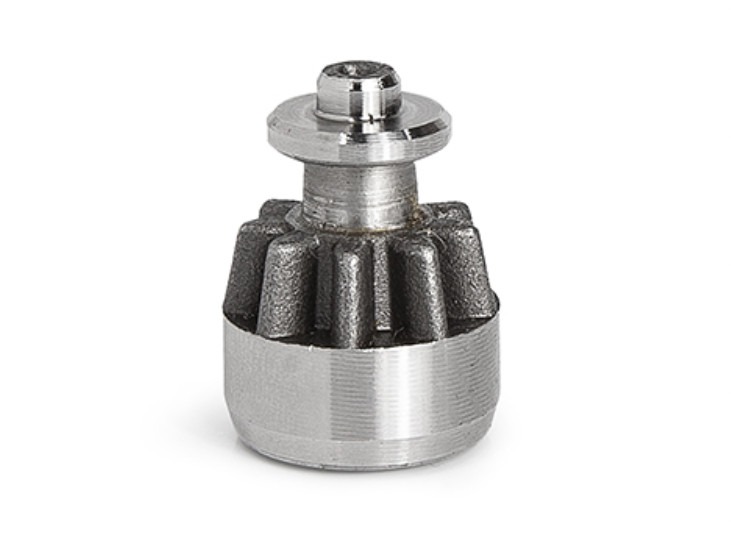
Satellites: also called drive pinions, are the elements that transmit the movement generated by the key to the spiral crown. Their function is to convert the manual rotation of the key into coordinated mechanical movement, allowing the jaws to open or close in a synchronized and uniform manner. The precision in the transmission is essential to ensure correct self-centering and avoid irregular wear of its components.
As for the manufacturing materials, they are usually made with treated or hardened alloy steel , since they must withstand repetitive stress and constant friction without deforming or losing precision. In some cases of high-end industrial plates, forged steel can be used to improve durability and resistance to prolonged wear.
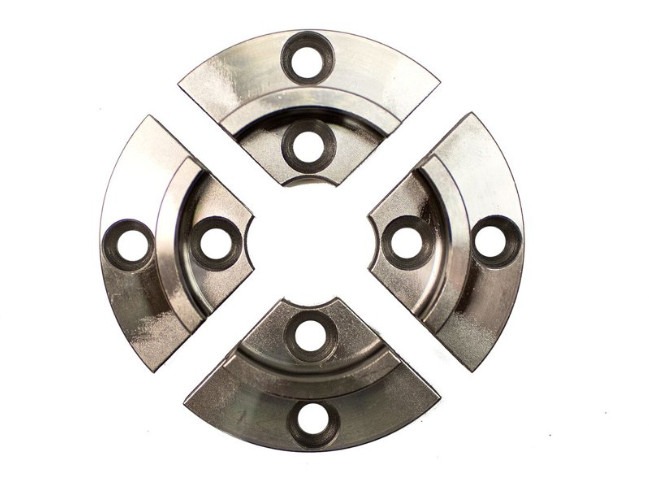
Internal jaws: or clamping pins, these constitute the main contact points between the plate and the piece, being the elements that firmly hold the material during turning. Distributed equidistantly, in X and Y coordinate axes, they allow a balanced clamping that avoids vibrations and displacements, guaranteeing precision and safety. Their design and mechanism may vary depending on the brand or model of the plate, but they always have the function of efficiently transmitting the force applied by the clamping system. In terms of materials, the jaws are usually made with treated steel , which offers resistance and durability, or with alloy steel hardened in high-end professional equipment, to ensure a long service life and resistance to wear. In some specific industrial plates, nodular cast iron can also be used, especially when a combination of rigidity and a certain toughness is sought.
The jaws have a numbering for their correct positioning and gearing on the spiral crown.
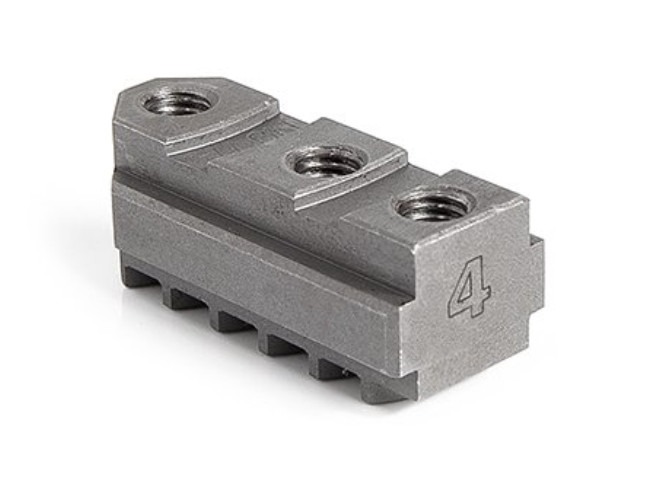
External jaws: these are additional elements that are mounted and fixed directly on the internal jaws, which are the ones that perform the radial displacement according to the X and Y coordinate axes . These internal jaws act as a mechanical base, while the external jaws allow the clamping system to be adapted to very diverse geometries and needs. Usually, the external jaws are fixed using two or three screws , guaranteeing a rigid and precise union, although in some more modern systems quick fixing mechanisms are also used, without screws , which facilitate agile assembly and disassembly without losing reliability. This modularity allows them to be replaced quickly depending on the type of piece or operation to be performed.
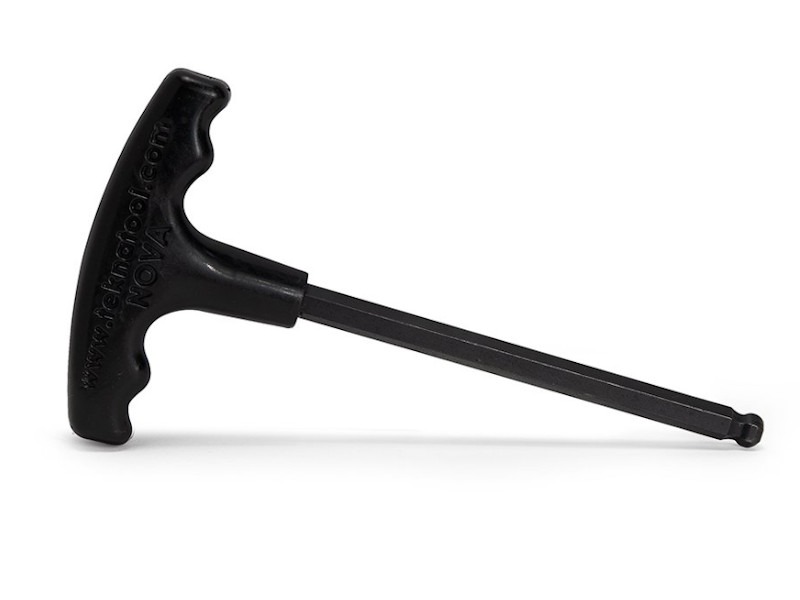
Operations key: this key, also known as a clamping key, is the manual tool that allows the application of the torque necessary to open or close the jaws of the universal plate. Using this key, the turner transmits the movement to the satellites or drive pinions and, through the spiral crown, to the jaws, achieving synchronized radial displacement and self-centering of the piece.
These keys can have different shapes; they can be hexagonal Allen type , ideal for precise adjustments, square , more classic and resistant, or flywheel type key , which facilitate the operation with less effort and allow faster rotation. The choice of the type of key directly influences the ease of use and safety during the fastening process. Correct use of the key ensures that the jaws exert the appropriate force on the piece without overloading or risk of damage to the mechanism.
Back cover:
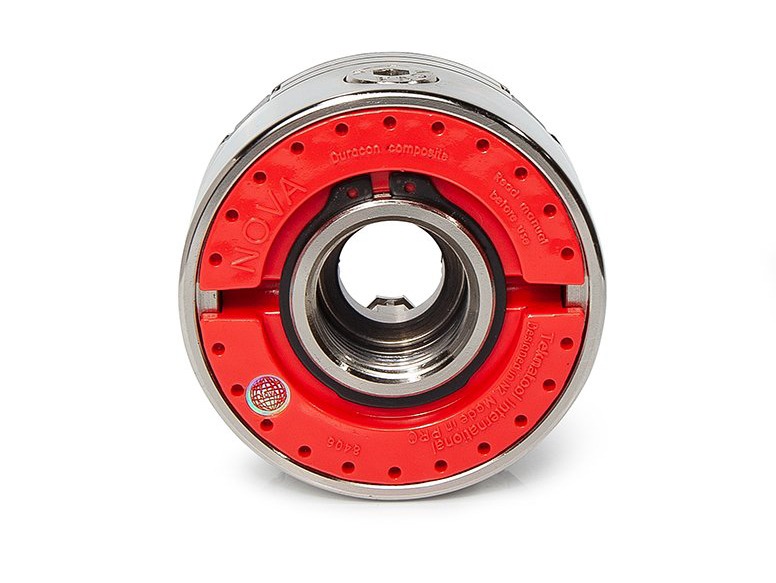
The back cover is usually made of hard plastic or the same steel material as the body of the platter. By removing this maintenance cover, we can directly access all the internal components, either for a visual inspection or for more thorough and in-depth periodic maintenance.
Maintenance
The maintenance of the universal plate is essential to guarantee precision, safety and a long service life of all its components. The fine dust generated during turning or sanding processes penetrates the plate and mixes with its lubricating components, generating a dry paste over time. For this reason, it is necessary to regularly clean and lubricate the entire mechanism, especially the satellites, drive pinions and spiral crown, to ensure smooth and uniform movement of the jaws. It is important to periodically check the condition of all these components, as any deterioration can affect self-centering and the force applied. It is necessary to avoid impacts, overloads and the use of torques higher than those recommended for wood, as they can deform the mechanism or mark the parts. Correct maintenance not only extends the life of the plate and its components, but also guarantees a stable and safe hold during work.
The universal plate or jaw plate is much more than a simple accessory: it is a mechanical system for transmitting radial forces, critical for safe and efficient machining. In wood turning:
- A good design of external jaws allows working with low and safe pressure
- Calculating the force and pressure applied helps adjust manual fixation
- Centering, self-centering and symmetry guarantee a secure hold and quality
This knowledge is essential to transform the lathe into a precise, safe and versatile tool, maximizing the quality of the finishes and minimizing the risk of damage to the wood.